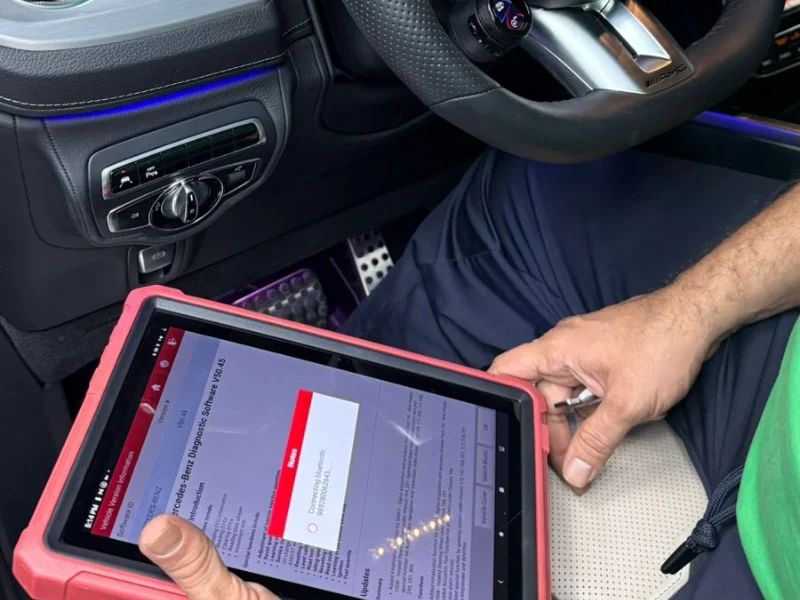
When a warning light keeps coming back, or three garages have already "cleared the code," you need a workshop that treats diagnostics as engineering — not guesswork.

Tell us what the car is doing. We'll respond within 2 hours during opening hours.
If any of that sounds familiar, you’re in the right place.
We don’t rely on a single universal scanner. Every major European marque has its own factory software, and we’ve invested in the real thing for each one:
A generic OBD-II scanner only reads the standardised slice of a car’s fault memory. It can’t see manufacturer-specific codes, it can’t read sub-modules, and it can’t tell you whether a fault was coded wrong at the factory or by a previous garage.
That’s the reason the light keeps coming back after a cheap scan.
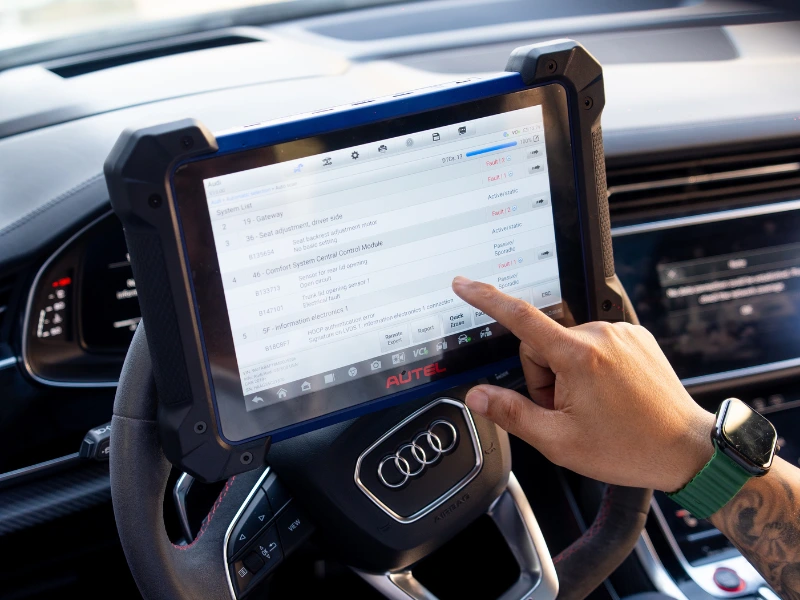
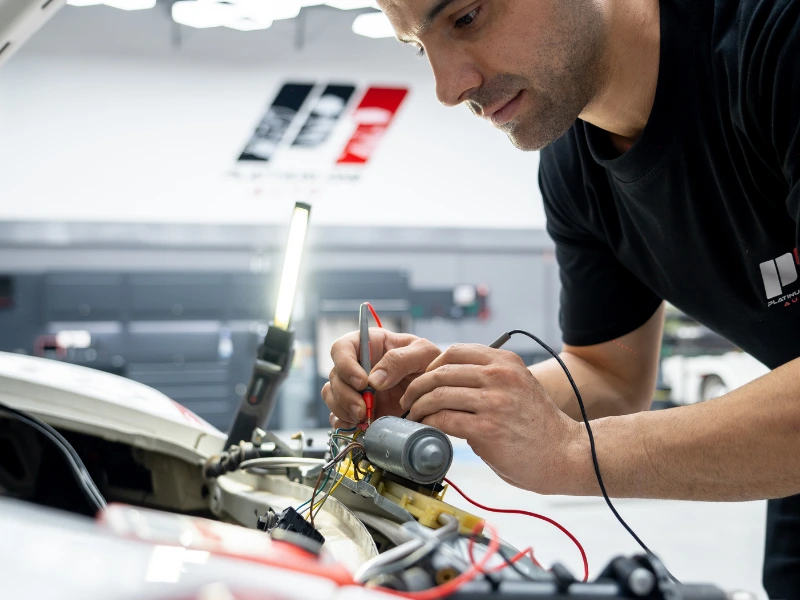
We could charge AED 150 and run a 10-minute scan like everyone else. We don’t, because it doesn’t fix anything. A proper diagnostic on a modern European car takes 60–120 minutes of senior technician time, dealer software licences that cost us tens of thousands of dirhams a year, and equipment the average workshop doesn’t own.
What you’re paying for is the answer, delivered once — not a cheap scan followed by four return visits.
If we diagnose your car and you choose us for the repair, the diagnostic fee is credited back against the repair cost.
I would have to say the work done in this workshop is really professional. The people were very cooperative and helpful. I went in there using their free diagnostic offer & after a thorough diagnostic they mentioned everything that had to be done and now my Porsche is as good as new. Truly an amazing work.
 Darnelldc Coelho
 I had a great experience with this garage! It’s a new place, but they really impressed me with their professionalism and quality of work. I had been to several places before, but no one could solve the issue—here, they got it done quickly and efficiently. Highly recommended!
wonderful garage! European quality as we know it! thanks guys! 3 garages could not find the error! well dun
The usual triggers are a warning light that won't go away, intermittent faults that come and go without warning, difficulty starting, or a vehicle that simply feels "off" without an obvious cause.
Modern cars rarely fail loudly — they whisper first through the electronics. If something isn't right, a proper diagnostic is almost always the fastest route to the answer.
A generic OBD-II scanner reads the standardised slice of fault memory that every car on the road shares.
It can't see manufacturer-specific codes, it can't reach sub-modules, and it can't test anything physically. We run the actual factory software for each marque — ISTA for BMW, XENTRY for Mercedes, ODIS for Audi, VW and Porsche — and we back it up with oscilloscope and voltage testing on the wiring itself.
That's usually the difference between a fault that gets found and a fault that keeps coming back.
No. Clearing a code without understanding the cause is the single reason warning lights return a week later.
Every diagnostic we carry out finishes with a written explanation of the root cause, and every repair finishes with a re-scan and a road test before you collect the car.
Most diagnostics are completed the same day, usually inside 60–120 minutes.
Intermittent faults that only appear when the car is cold, wet, or has been standing overnight may need us to keep the car longer so we can recreate the conditions — we'll always agree that with you first.
It's rare, but it happens — and we'll tell you honestly if it does.
If we can't give you a clear answer, we won't charge you for a diagnostic we haven't delivered.
We'd rather lose the fee than lose your trust.
Yes. Our bay is set up for the major European marques — BMW, Mercedes-Benz, Audi, Volkswagen, Porsche, Range Rover, Bentley, Maserati — plus most Japanese and American vehicles.
Whether it's a German Sedan, a British SUV or an Italian sports car, we have the manufacturer software to talk to it properly.
Our technicians are equipped to diagnose and resolve electrical issues with precision — backed by flexible scheduling and a comfortable waiting area while we test, scan, and restore your vehicle’s systems.